October 2, 2025
Insights from James Scott, Head of Advisory Services at Growth Molecule
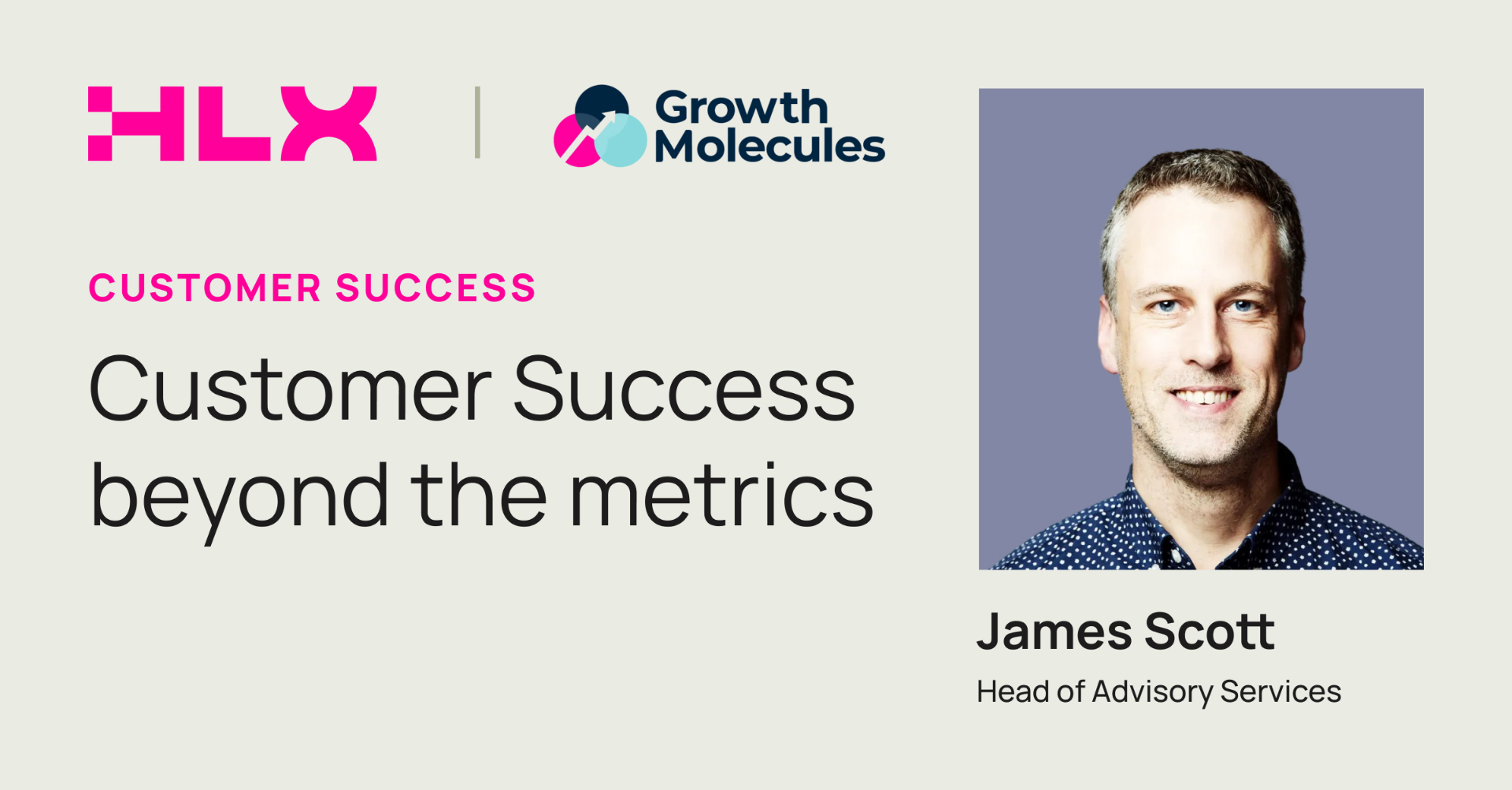
If customer success (CS) were a bingo game, everyone would have won by now. "Adoption rates!" "Engagement scores!" "Sentiment analysis!" You'd be marking squares left and right as teams chase these metrics like they're the jackpot of retention. But when we sat down with James Scott, Head of Advisory Services at Growth Molecules, the customer success delivery arm of HLX. He shared an uncomfortable truth: while you've been obsessing over these secondary metrics, your customers have been quietly questioning whether your product is actually worth renewing.
The Great Customer Success Misdirection
"As an industry, we've really over-indexed on things like adoption and engagement and sentiment," says James Scott, Head of Advisory Services at Growth Molecules, the customer success arm of HLX. "They're all important, but they're only secondary metrics. The thing that really determines whether a customer renews or expands is: do they perceive value from your product?"
It's a reality check in an era where CFOs are wielding budget axes with surgical precision. While CS teams celebrate 90% feature adoption rates, customers are having very different conversations in boardrooms, conversations about ROI, cost reduction, and whether that shiny SaaS tool is actually moving the needle.
The Renewal Reality Check: It's Not About You
Here's where most customer success strategies go sideways: they assume renewal conversations start 30 days before the contract expires. Wrong. By then, you're essentially asking someone to defend a decision they've already made.
"It's so hard to do [the renewal] if you leave it till the last minute," Scott explains. "You're in the renewal conversation scrambling. It's much better to start having these conversations around your value story, identifying people that need to be influenced earlier."
But here's the plot twist: it's not just about starting earlier. It's about recognizing that your customer isn't one person but rather an ecosystem of stakeholders, each with their own definition of value. The admin who loves your user interface? Different value. The CFO worried about budget efficiency? Completely different value. The end-user who actually gets work done with your tool? Yet another type of value.
Beyond the Single-Threaded Relationship Trap
The days of betting everything on your champion contact are over. "There's a lot more risk of renewal if it's all one person kind of sticking up for you internally," Scott notes. "But if you can build an internal consensus of different people who are all talking about the value you provide from different perspectives, then that's much more compelling."
Think of it as customer success diplomacy. You're not just maintaining one relationship but rather building a coalition of advocates, each armed with a value story that resonates with their specific role and concerns.
AI Won't Save Your Broken Fundamentals
Before you start dreaming about AI-powered customer success automation solving all your problems, pump the brakes. "AI isn't a replacement for the fundamentals," Scott warns. "It's an accelerant."
The companies succeeding with AI in customer success aren't the ones trying to replace human judgment with algorithms. They're the ones using AI to supercharge processes they've already proven work manually. Start with controlled experiments, test with subsets of clients, and never—ever—let AI touch your core revenue-protecting processes until you're absolutely certain it works.
The Scale-Without-Sacrifice Formula
Want to scale customer success without turning into a digital spam machine? Stop automating your assumptions. "Find the thing that works by doing it manually first," Scott advises. "Once you find the recipe that works, then look at ways you can use digital operations to do that thing more efficiently."
The mistake? Building elaborate campaigns around what you think customers want, then scaling that mistake across your entire base. It's like mass-producing a recipe you've never actually cooked.
The Value-Centric Future for Customer Success
The customer success organizations winning right now aren't the ones with the fanciest dashboards or the most sophisticated automation. They're the ones obsessively focused on understanding what value means to each customer. Then they deliver communications, features, and relationships that align with those specific value definitions.
"Every customer is in a different place in their journey, looking for value in different ways," Scott explains. "The key is understanding: for this customer, they care about this piece of value right now."
It's customer success, but all grown up. Less generic messaging, more targeted precision. Less feature evangelism, more understanding what actually matters to each customer.
Because at the end of the day, your customer doesn't care about your product roadmap. They care about whether you're helping them achieve their goals. Master that, and retention becomes a byproduct, not a battle.
Ready to Focus on What Actually Matters?
If you're tired of watching perfectly good renewal conversations turn into discount negotiations, it might be time for a value reality check. Growth Molecules and HLX help organizations move beyond vanity metrics to build customer success strategies that actually protect and grow revenue.
Get started to discover what value really looks like at your organization. Fair warning: we might challenge some assumptions you didn't even know you had. But if you're ready to turn retention from a nail-biter into a foregone conclusion, that conversation might be the best 30 minutes you'll spend this quarter.
Ready to transform your customer success strategy?
Connect with Growth Molecules and HLX to move beyond vanity metrics and build strategies that actually protect and grow revenue.
Get Started